Study Notes: Chapter 1 – Introduction to Bitcoin
1. What is Bitcoin and Why Does It Matter?
Q1: How would you describe Bitcoin in simple terms?
Bitcoin is a digital cash system that lets people transfer value (called
bitcoins) directly to one another over the internet, without
relying on banks or governments. It’s “peer-to-peer” money, meaning no central
authority is in charge.
Q2: What do we mean by "Bitcoin network"?
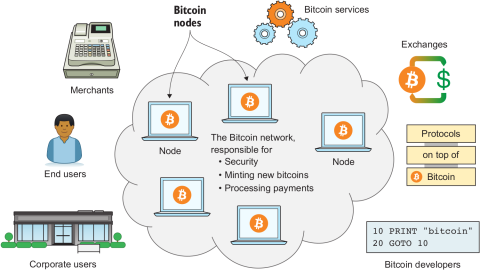
The Bitcoin network is made up of thousands of computers (known as
nodes) around the world. These nodes run Bitcoin software
and collectively verify, process, and record all Bitcoin transactions.
Q3: Does anyone control or own Bitcoin?
No single entity controls Bitcoin. It is decentralized, meaning
no individual government, company, or person dictates its rules or operation.
Anyone, anywhere, can use it without permission.
2. The Big Picture: How a Bitcoin Payment Works
The overall process of sending and receiving bitcoins can be understood in
four key steps:
Q4: What are the four steps in a typical Bitcoin transaction?
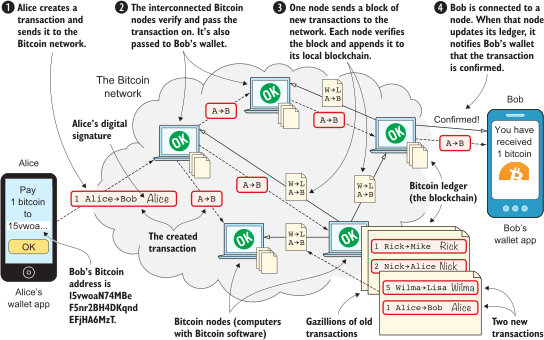
- Create and sign: Alice makes a transaction that instructs
1 BTC to go to Bob’s address. She signs it digitally using her private key.
- Broadcast to network: The transaction is sent out to
Bitcoin nodes. Each node checks if Alice has enough funds and if her
signature is valid.
- Add to blockchain: Miners bundle valid transactions into
a block and append it to the blockchain (the ledger of all
transactions).
- Notify wallets: Bob’s wallet sees that the transaction has
been included, and confirms that he received 1 BTC.
Q5: What is the blockchain?
The blockchain is an append-only database or ledger
shared by all nodes. It stores every Bitcoin transaction ever made in
blocks that are cryptographically linked.
Q6: Who gets to add new blocks to the blockchain?
Special nodes called miners try to solve a difficult
cryptographic puzzle. Whichever miner solves it first creates a new block
and is rewarded with newly minted bitcoins plus any transaction fees from
the block.
3. Problems With Traditional Money
Bitcoin tries to address several issues found in today's financial systems.
Q7: What are four major problems that Bitcoin aims to solve?
- Segregation: Many people lack bank access due to cost,
documentation, or discrimination.
- Privacy issues: Traditional electronic payments can be
traced, censored, or frozen by centralized parties.
- Inflation: Many national currencies suffer from
inflation or even hyperinflation if too much money is printed.
- Borders: Moving value across countries is often slow,
expensive, or restricted.
4. The Bitcoin Approach
Q8: How does Bitcoin address these problems?
Bitcoin’s design rests on three pillars:
- Decentralized: No single point of control means
no censorship or forced exclusion.
- Limited supply: Only 21 million bitcoins will
ever be created, resisting the inflation found in fiat currencies.
- Borderless: Anyone with an internet connection
can transact globally, often at lower fees than traditional methods.
5. Real-World Use Cases
Q9: What are common scenarios where Bitcoin is actually used?
- Savings: You can store bitcoins securely using
private keys. Some users treat Bitcoin like digital gold.
- Cross-border payments: Faster and potentially cheaper
than services like Western Union, especially where local banking is weak.
- Shopping: Online stores (and some physical shops)
accept Bitcoin to avoid credit card fees or risk.
- Speculation: Due to its volatility, some people
buy/sell bitcoins hoping for profit.
- Noncurrency uses: Using Bitcoin’s blockchain for
ownership records or proof-of-existence of documents.
Q10: When might Bitcoin not be ideal?
Bitcoin transactions can incur relatively high fees (especially for
tiny amounts), and confirmations can be slow (about 10 minutes or more).
Also, security demands can be a challenge for new users, and price
volatility remains a factor.
6. Other Cryptocurrencies (Alt-coins)
Q11: Are there alternatives to Bitcoin?
Yes. There are many “alt-coins” (e.g., Ethereum, Solana, Monero, Zcash) that
introduce unique features like complex smart contracts or enhanced privacy.
However, Bitcoin remains the largest and most established.
- Ethereum: Focuses on running decentralized applications (dApps) and smart contracts. However, it
is highly centralized, with a small group of developers controlling its direction. Its supply schedule
has been random and not auditable, and verifying its blockchain is too resource-intensive for
individuals - leaving control to a handful of powerful validators. Overall, its security and
architecture are far inferior to Bitcoin.
- Monero: Emphasizes privacy and anonymity, but is also centralized, lacks Bitcoin’s robust
security, and remains vulnerable to a small group of developers who control its direction.
- Solana: Aims to provide high throughput and speed, but is extremely centralized, has experienced
multiple outages, and relies on powerful hardware - placing control in the hands of a few large
validators rather than a decentralized network.
- Zcash: Focuses on privacy through different cryptographic techniques. It is also governed by a
tight-knit team of developers, and its lack of widespread adoption and decentralization make it far less
secure and trustless than Bitcoin.
- Namecoin: Used for decentralized domain name registration, but it has failed to gain significant
traction and is largely controlled by a few entities.
Buyer Beware: Unlike Bitcoin, which is decentralized and secure, most altcoins are technically unsound,
centralized, and controlled by a handful of people or organizations. They often serve as a means for developers
to dump premined tokens on unsuspecting buyers, making them risky investments. Bitcoin remains the only
cryptocurrency with a proven track record of decentralization, security, and sound architecture.
Q12: Why is Bitcoin's “network effect” important?
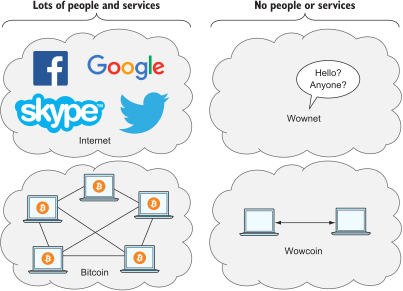
The more people use a currency, the more useful it becomes.
This effect makes it hard for new coins to challenge Bitcoin unless they
offer significant improvements or specialized features.
7. Key Takeaways
- Bitcoin is a global, borderless form of digital money.
- The Bitcoin network is a collection of thousands of
computers (nodes) verifying and recording transactions.
- Transactions involve private keys (to authorize sending)
and public addresses (to receive).
- The blockchain is an append-only ledger containing
all valid transactions.
- Bitcoin aims to solve issues of segregation, privacy, inflation,
and cross-border friction by being decentralized, limited in
supply, and permissionless.
- Unlike Bitcoin, most altcoins are centralized, insecure, and controlled by a small group of developers and
validators, making them risky investments.
8. Additional Readings
-
Bitcoin: A Peer-to-Peer Electronic Cash System
Author: Satoshi Nakamoto
Summary: The original whitepaper introducing Bitcoin, detailing its purpose, mechanics, and underlying philosophy.
-
The Bullish Case for Bitcoin
Author: Vijay Boyapati
Summary: An in-depth analysis of Bitcoin's value proposition, addressing common misconceptions and highlighting its potential as a global monetary system.
-
Stone Ridge 2020 Shareholder Letter
Author: Ross Stevens
Summary: Articulates Stone Ridge's bitcoin thesis through 1st-principles arguments and describes the founder's "aha moments" pertaining to bitcoin.
-
Bitcoin Is Worse Is Better
Author: Gwern Branwen
Summary: This essay discusses how Bitcoin exemplifies the 'Worse is Better' paradigm, where a design that is seemingly less elegant succeeds due to its practical implementation and gradual refinement.
-
Bitcoin is Time
Author: Gigi
Summary: Discusses the concept of Bitcoin as a decentralized clock, exploring its role in synchronizing a global network without central authority.
-
Bitcoin's Academic Pedigree
Author: Arvind Narayanan and Jeremy Clark
Summary: Bitcoin didn't simply appear out of thin air - it was built upon decades of work and came after many failed digital currency projects.
End of Study Notes for Chapter 1. Keep these key points in mind as you delve deeper into Bitcoin’s technical
and practical aspects!