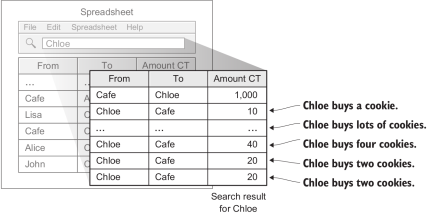
Figure 2. Acme Insurances looks at cookie-eating habits to adjust premiums.
Q1: Why can using names in our ledger (or spreadsheet) be a privacy problem?
Because outsiders (like an insurance company) could identify who is sending and receiving. They could see how many cookies (or how many bitcoins) someone is spending. It compromises personal and financial privacy.
Q2: How does replacing names help?
Instead of names, the spreadsheet will list only public key information.
That way, transactions appear like “PublicKey_A to PublicKey_B,”
making it harder to see who is who.
Q3: After dropping personal names, what do we store in the spreadsheet instead?
We store public key hashes (PKHs). Each public key is first hashed with SHA256, then hashed again with RIPEMD160, resulting in a 20-byte PKH.
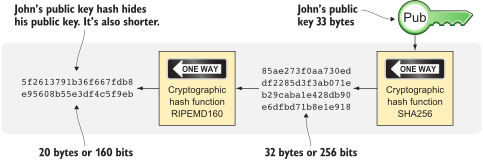
Q4: Why shorten public keys to 20-byte PKHs?
Q5: Does replacing names with PKHs solve all privacy concerns?
Not entirely. PKHs are pseudonyms, but any link between a PKH and its real owner can still reveal someone's entire transaction history. So it's better, for privacy, to use multiple PKHs (or addresses).
Typing a 20-byte PKH by hand can be error-prone. A single character mistake can send funds into the void. Enter Bitcoin addresses (or cookie token addresses), which include a checksum.
Q6: What is a Bitcoin (cookie token) address in this analogy?
It’s the PKH plus:
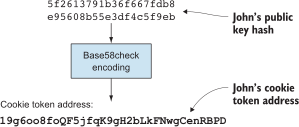
Q7: How does base58check encoding help reduce errors?
0 (zero) vs. O (capital O), reducing confusion.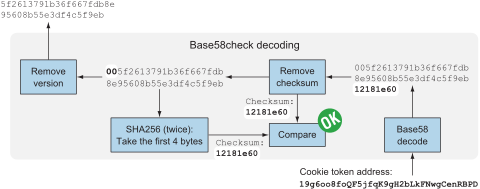
Q8: Can Acme Insurances still track your cookie-eating if they identify your PKH or address just once?
Potentially yes. Once they match your PKH to you, they see all your spreadsheet activity tied to that PKH. But if you frequently use new PKHs or addresses, it’s harder to link them all to you.
Q9: Is there any drawback to using many addresses?
It can be a bit more complex to manage, but modern wallet software automates generating new addresses and keeping track of them, improving privacy and security.
End of Study Notes for Chapter 3. You now understand how Bitcoin addresses (PKH + base58check) reduce errors and improve privacy over using names or raw public keys!